
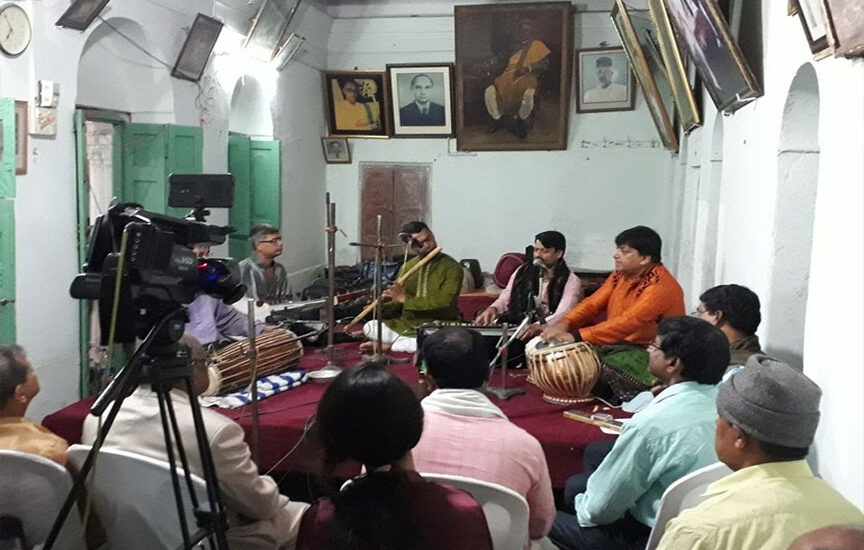
The Royal Legacy of Panchetgarh Rajbari
Panchetgarh Rajbari occupies a place of immense pride in India’s cultural and musical history due to its deep association with the legendary Dhrupad maestro Jadubhata. This historic Rajbari was not merely a royal residence but a vibrant centre of classical music, learning, and spiritual refinement.
It was here, within the dignified walls of Panchetgarh Rajbari, that Jadubhata lived, taught, composed, and left behind an indelible legacy that would later shape the cultural soul of India.
Jadubhata: The Dhrupad Maestro
Jadubhata was one of the greatest exponents of Dhrupad, the oldest and most profound form of Hindustani classical music. Despite his remarkably short life span of around 42 years, his contribution to Indian music remains timeless.
His genius was recognised far and wide, and his influence extended beyond music into the literary and nationalist consciousness of India.
Teacher to Legends of Indian History
One of the most extraordinary aspects of Jadubhata’s life is that he taught music to:
-
Rabindranath Tagore, who later became Kavi Guru and composed India’s National Anthem “Jana Gana Mana”
-
Bankim Chandra Chattopadhyay, the author of “Vande Mataram”, India’s National Song
It is widely believed that the first musical composition of “Vande Mataram” was composed by Jadubhata himself for Bankim Chandra Chattopadhyay — a historic moment that connects Panchetgarh Rajbari directly to the soul of the Indian freedom movement.
Jadubhata at Panchetgarh Rajbari
During his lifetime, Jadubhata served as the Court Musician and Shiksha Guru at Panchetgarh Rajbari.
He trained disciples within the royal court and imparted musical education to members of the royal family.
Although his stay at Panchetgarh Rajbari lasted for around six to eight months, the impact of his presence was profound and enduring.
The “Gaaner Khata”: A Living Treasure
Before leaving Panchetgarh Rajbari, Jadubhata left behind one of his most priceless contributions — his “Gaaner Khata”, or handwritten songbook.
This rare manuscript, written in his own handwriting, is a living testament to his musical genius and creative spirit.
The sacred book is still carefully preserved and cherished by:
Smt. Aparna Chaudhary (Dasmahapatra)
of the Panchetgarh Rajbari family
This priceless artefact stands as a bridge between the past and the present, connecting today’s generations to a golden era of Indian classical music.
Panchetgarh Rajbari: Where Music Meets Spirituality
Panchetgarh Rajbari was more than a court — it was a sanctuary of art, devotion, and learning. Music here was deeply intertwined with spirituality, Vaishnav traditions, and royal patronage.
The association of Jadubhata with Panchetgarh Rajbari elevates the Rajbari’s stature as a historic cradle of Indian classical music.
A Heritage That Still Resonates
Today, Panchetgarh Rajbari continues to echo with centuries of history, devotion, and artistic brilliance.
The story of Jadubhata is not merely a chapter from the past — it is a living legacy that defines the cultural identity of Panchetgarh.
Visitors and music lovers alike stand humbled before the realization that within this sacred land, melodies were once shaped that went on to inspire a nation.
Panchetgarh Rajbari
Where Royalty, Music, and History Unite
